Take control of utilities
Making level measurement in utilities simpler, safer and more cost-effective
Utilities may operate outside the main production process, but when level measurement fails, the impact can quickly be felt across the entire plant. Inaccurate or unreliable measurements can lead to unnecessary pump operation, overfills, process disruptions and unplanned maintenance interventions.
For plants with dozens or even hundreds of utility measurement points, the challenge is not simply finding a sensor that works. It is finding a practical way to standardise level measurement that is easy to specify, install, verify and maintain without adding unnecessary cost or engineering effort.

How much does each measurement point cost to manage?
Utility applications can involve a large number of relatively straightforward level measurements. However, even minor complexities in specification, installation or maintenance can become significant across the plant.
Choosing instrumentation that is appropriately matched to the application can make it easier to standardise equipment, reduce the number of device variants that need to be specified and stocked, and control the overall cost of measurement. One-for-one replacement can also help reduce disruption when an instrument reaches the end of its service life.
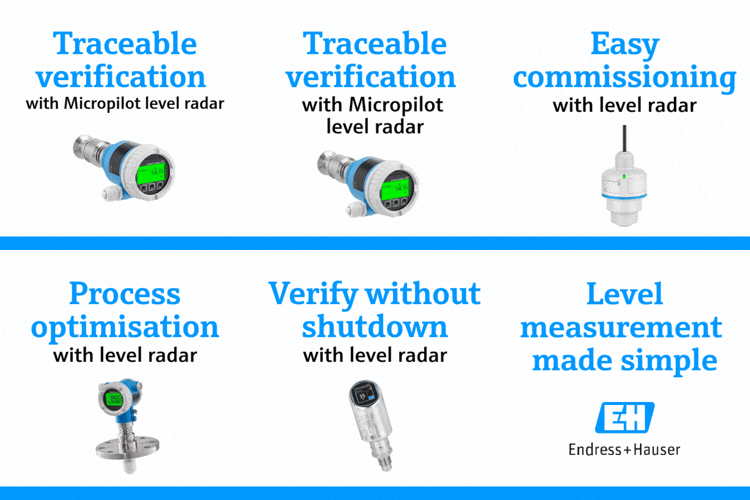
Endress+Hauser’s Micropilot FMR10B, FMR20B and FMR30B level sensors provide 80 GHz radar level measurement for standard utility applications, providing a cost-effective approach where more complex instrumentation may not be necessary.
Can commissioning be made less demanding?
For plants with large numbers of measurement points, commissioning can become a significant drain on engineering and maintenance resources, particularly when instruments are located in hard-to-reach areas or require specialist expertise to configure.
A simpler commissioning process can reduce the time spent getting instruments into service and make it easier for plant personnel to manage routine tasks themselves. The Micropilots’ guided setup sequences help users work through commissioning step by step, with the devices designed to enable setup in just a few minutes.
Remote access via a smartphone or tablet can further reduce the need to physically access the instrument, while device identification features can help engineers quickly locate the correct measurement point.

How do you know the measurement is still reliable?
Commissioning an instrument correctly is only the beginning. The real challenge is maintaining confidence in the measurement throughout its operational life.
Traditional verification methods often require physical access to the instrument or interrupting the process. Being able to verify performance in situ can reduce this burden and help maintenance teams identify potential problems before they affect operations.
Heartbeat Technology enables on-demand diagnostics and verification without removing the instrument or interrupting the process. Verification can be completed in less than three minutes, while the Radar Accuracy Index (RAI) compares the instrument’s measured performance with its original reference values. The documented verification process provides traceable evidence for compliance purposes.
For teams responsible for multiple assets, this can support a shift from reactive maintenance towards a more proactive approach.
Can remote access be convenient without compromising security?
Utility instruments are not always installed in convenient locations. They may be positioned at the top of tall process tanks, in areas with congested pipework or in numerous other places where physical access takes time and effort. Remote access helps simplify these tasks by allowing instruments to be commissioned, configured and diagnosed without the need for direct physical access. However, as connectivity increases, so does the importance of robust cybersecurity.
Micropilot level sensors support secure Bluetooth access, allowing engineers to work with the instruments from a smartphone or tablet, reducing the need for a physical connection for many routine activities. To protect against evolving cyber threats, Endress+Hauser has incorporated CPace security technology into its Bluetooth connection. CPace is a password-authenticated, third-party approved key exchange mechanism designed to establish secure communication while protecting against unauthorised access and cyberattacks.
The result is a more practical way to access instruments in hard-to-reach locations while taking security requirements into account.
Making hundreds of small decisions easier
When assessing which level instrumentation is right for you, the measurement it provides is not the only consideration. The effort required to manage that measurement throughout its life cycle also has to be taken into account.
The Micropilot FMR10B, FMR20B and FMR30B are designed for basic level applications in all process industries. Their focus on cost-effective measurement, straightforward commissioning, traceable verification and secure remote access addresses some of the recurring operational challenges associated with managing large numbers of utility measurement points.
Conquering those challenges makes every measurement point easier to manage – reducing engineering effort at installation, simplifying maintenance and verification, and helping control life cycle costs across the plant.
For more information please visit The simpler, the better: Micropilot FMR10B, FMR20B and FMR30B. | Endress+Hauser
Endress+Hauser Ltd. Floats Road, Manchester M23 9NF